
Urgent care can start process of checking for blood clots, but most locations cannot confirm a diagnosis on their own. Many urgent care centers can perform a physical exam, assess your risk factors, and run a D-dimer blood test to help determine whether a blood clot is likely. However, imaging tests needed to actually see and confirm a clot, like a duplex ultrasound or CT scan, are often not available at standard urgent care facilities.
So short answer is: urgent care can be a useful first stop if you suspect a blood clot in your leg and your symptoms are not severe. But if your symptoms point to something more serious, like a clot in your lungs, you should go straight to emergency room.
What Can Urgent Care Actually Do?
When you walk into an urgent care center with concerns about a possible blood clot, the provider will typically start with a few things.
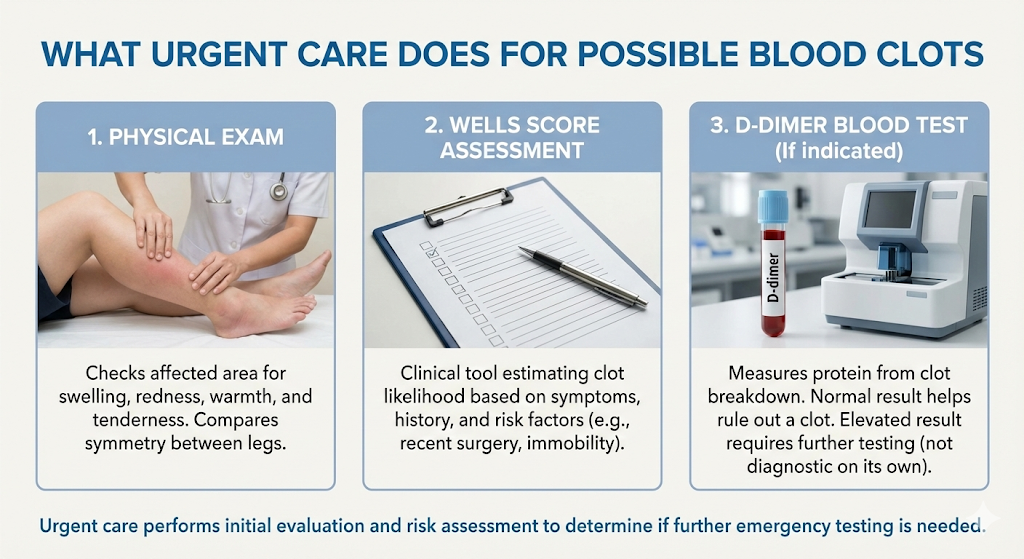
First, they will do a physical exam. They will look at affected area, usually your leg, for signs like swelling, redness, warmth, and tenderness. They will check whether one leg appears noticeably more swollen than other, which one of hallmark signs of a deep vein thrombosis (DVT).
Next, many urgent care providers use something called Wells Score. This is a validated clinical tool that assigns points based on your symptoms, medical history, and risk factors. It helps provider estimate how likely it that you actually have a blood clot. Things like recent surgery, prolonged immobility, active cancer, and one-sided leg swelling all add points to score. A low score means a clot less likely. A higher score means more testing needed right away.
If your Wells Score suggests a low to moderate risk, provider may order a D-dimer blood test. Many urgent care locations can run this test on-site. The D-dimer measures a protein fragment that your body produces when it breaks down blood clots. If your D-dimer comes back normal, it very good at ruling out a blood clot. A normal result combined with a low Wells Score generally enough to say that a DVT unlikely.
However, the D-dimer test has an important limitation. While it very sensitive, meaning it rarely misses a real clot, it not very specific. That means it can come back elevated for reasons other than a blood clot. Things like recent surgery, pregnancy, infection, inflammation, cancer, and even older age can cause a high D-dimer result without any clot being present. So a positive D-dimer does not confirm a clot. It just means further testing needed.
People also ask
Urgent care is reliable for assessing your risk and running initial screening tests like a D-dimer. However, they lack the imaging tools to provide a definitive diagnosis on their own. You should view them as a first step to determine if further testing is necessary.
The D-dimer test is highly sensitive, meaning it is excellent at identifying when a clot is not present. It is less specific, which means elevated levels can occur due to other factors like inflammation or recent injury. It is a screening tool rather than a final confirmation.
What Happens If Further Testing Needed?
This where most urgent care centers reach their limit. The definitive test for a blood clot in leg a compression ultrasound, also called a duplex ultrasound. This is a painless, noninvasive test where a technician presses a wand against your leg to visualize deep veins and check for clots. It is highly accurate for detecting clots in thigh veins, though it can sometimes miss smaller clots in calf.
Some urgent care locations, particularly larger ones or those affiliated with hospital systems, do have ultrasound capabilities. If you are unsure, it is worth calling ahead to ask. If your urgent care does not have an ultrasound, provider will refer you to a facility that does, either an imaging center or an emergency department, usually same day.
For a suspected pulmonary embolism (a blood clot in lungs), a CT angiography scan is typically needed. This type of imaging is not available at urgent care facilities. It requires an emergency department.
People also ask
A compression ultrasound, or duplex ultrasound, is the standard, painless test used to visualize veins and detect clots. While highly accurate for the thigh area, it can occasionally miss smaller clots in the calf. You may need to visit an imaging center or hospital to get this done.
A CT angiography scan is specifically used to diagnose a pulmonary embolism or a clot in the lungs. You would only require this if you are presenting with respiratory symptoms like sharp chest pain or trouble breathing. This test must be performed in an emergency department setting.
When Should You Skip Urgent Care and Go to ER?
Urgent care is reasonable when your symptoms are limited to your leg and you are otherwise feeling stable. But certain symptoms mean you need emergency care right away, because they may point to a pulmonary embolism, which is a blood clot that has traveled from a vein to your lungs. This is a life-threatening situation.
Go to emergency room or call 911 if you experience:
- Sudden shortness of breath that you cannot explain
- Sharp chest pain that gets worse when you breathe deeply or cough
- A rapid or irregular heartbeat
- Coughing up blood
- Feeling lightheaded, dizzy, or faint
- A sudden drop in blood pressure or feeling like you might pass out
A pulmonary embolism requires immediate diagnosis and treatment. Emergency rooms have CT scanners, blood thinners, and monitoring equipment needed to handle this. Waiting or going to urgent care first in this situation could cost valuable time.
People also ask
A clot becomes a medical emergency when it travels to the lungs, a condition known as a pulmonary embolism. This requires immediate intervention in an emergency room to monitor your heart and lungs. Do not attempt to visit urgent care if you have chest pain or breathing issues.
Sharp chest pain that intensifies when you take a deep breath or cough is a common indicator of a pulmonary embolism. Any sudden, unexplained shortness of breath should also be treated as a priority. These symptoms are signs that your body needs immediate emergency support.
What About DVT Symptoms That Feel Mild?
Sometimes a blood clot in leg does not feel dramatic at all. The pain might be steady but not severe, like a persistent ache deep in your calf. You might notice mild swelling in one leg that was not there day before, or skin might feel a little warmer to touch. These symptoms can be easy to brush off as a pulled muscle or a minor strain.
The difference is that muscle pain from a strain usually improves with rest and gets better over a couple of days. Blood clot pain tends to be persistent and concentrated in one spot, and it may actually get worse over time rather than better. If you have any doubt, it better to get checked than to wait. DVT affects an estimated 300,000 to 600,000 Americans every year, and early treatment with blood thinners can prevent the clot from growing or breaking off and traveling to the lungs.
What Are the Risk Factors Worth Knowing?
You are more likely to develop a blood clot if you have recently been through any of these situations:
- A long flight or car ride where you sat still for hours
- Recent surgery, especially on your hip, knee, or abdomen
- Extended bed rest or hospitalization
- A leg injury or fracture
- Taking hormonal birth control or hormone replacement therapy
- Pregnancy or the first few months after giving birth
- Active cancer or cancer treatment
- A personal or family history of blood clots
- Being over 60, a smoker, or significantly overweight
If you have one or more of these risk factors and you develop leg pain or swelling that does not have an obvious explanation, it worth getting evaluated sooner rather than later.
What Should You Do Right Now?
If your symptoms are limited to leg swelling, pain, or warmth and you are otherwise feeling fine, an urgent care visit is a reasonable and often faster first step. The provider can examine you, calculate your risk, and run a D-dimer test. If everything comes back low risk, you can feel reassured. If D-dimer is elevated or your risk score high, they will get you to right place for imaging quickly.
If you have any chest symptoms, trouble breathing, or feel faint, skip urgent care entirely and head to ER. Blood clots in lungs need emergency attention, and ER equipped to handle that. most important thing to take your symptoms seriously and not assume it will just go away on its own.
