
The recommended maintenance dose of tirzepatide for weight management is 5 mg, 10 mg, or 15 mg once a week, depending on how your body responds to medication and how well you tolerate it. After you have reached your weight loss goal, the research strongly suggests that staying on medication at an effective dose is key to keeping weight off. Stopping tirzepatide after losing weight almost always leads to significant regain.
That probably not what you were hoping to hear. But understanding why continued treatment matters and what your options look like can help you plan ahead and work with your doctor to find approach that fits your life best.
Why Does Weight Come Back If You Stop?
Tirzepatide works by activating two hormone pathways in your body called GLP 1 and GIP. These hormones help control your appetite, slow down how quickly food leaves your stomach, and improve how your body handles blood sugar. While medication is active, it reduces hunger, helps you feel satisfied with smaller meals, and supports your metabolism.
But tirzepatide does not permanently reset how your body regulates weight. Once you stop medication, those hunger hormones come back, your appetite increases, and your metabolism can slow down as your body tries to return to its previous weight. This is not a willpower issue. It biology. Your body has built in defense systems designed to regain lost weight, and without ongoing support, those systems often win.
What Does Research Show About Stopping?
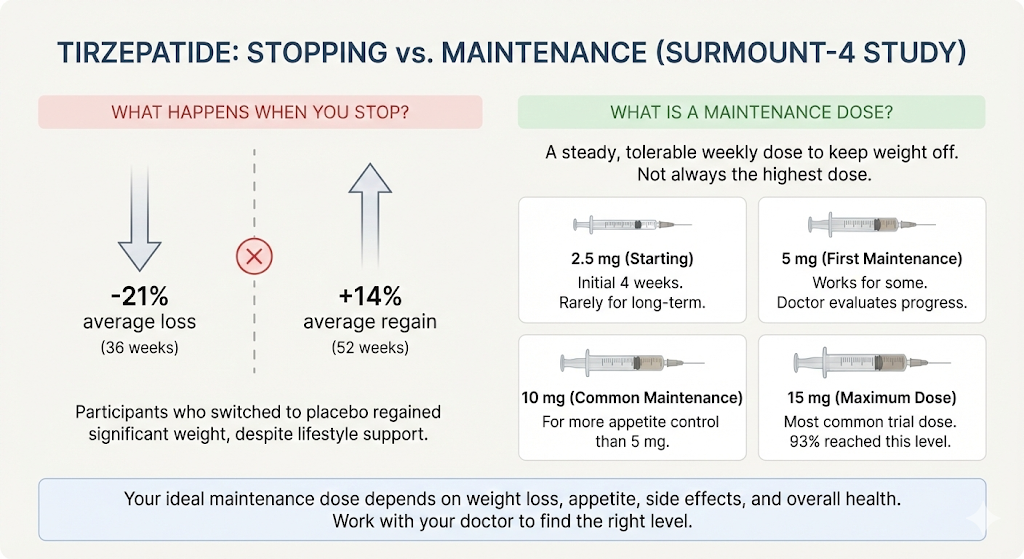
The strongest evidence comes from a major clinical trial called SURMOUNT 4. In this study, participants took tirzepatide at their maximum tolerated dose (10 mg or 15 mg weekly) for 36 weeks and lost an average of about 21% of their body weight. That a remarkable result.
After those 36 weeks, half group continued tirzepatide and other half switched to placebo injection. The results over next 52 weeks were striking. People who continued medication lost an additional 5.5% of their body weight. But those who stopped medication regained an average of 14% of their body weight during same period.
Even more telling, participants who stayed on tirzepatide were far more likely to maintain at least 80% of their initial weight loss. The people who switched to placebo lost most of those gains despite still receiving nutritional counseling and lifestyle support.
What Does a Maintenance Dose Actually Look Like?
Your maintenance dose is steady weekly amount that keeps weight off while being tolerable for you over long term. It is not always same as your highest dose during weight loss phase. Your doctor will work with you to find the right level.
Here how doses typically break down:
- 2.5 mg weekly is the starting dose used during first four weeks. It is not intended for long term weight management, though in rare cases some patients stay on it if they lose weight quickly or cannot tolerate higher doses.
- 5 mg weekly the first true maintenance dose and works well for some people. Your doctor will evaluate your progress at this level before deciding whether to increase.
- 10 mg weekly is common maintenance dose for many patients who need more appetite control or weight support than 5 mg provides.
- 15 mg weekly maximum dose and what most participants in clinical trials ended up taking. About 93% of participants in SURMOUNT 4 reached 15 mg as their maximum tolerated dose.
Your ideal maintenance dose depends on several things: how much weight you have lost, how your appetite is behaving, what side effects you are experiencing, and what your overall health looks like. Some people do well at 5 mg long term. Others need 10 mg or 15 mg to keep hunger and weight regain at bay.
Can You Lower the Dose After Reaching Your Goal?
Many patients and doctors are interested in whether stepping down to lower dose can still maintain results while reducing side effects and cost.
There is an ongoing clinical trial called SURMOUNT MAINTAIN that specifically studying this question. It compares continuing maximum tolerated dose against stepping down to 5 mg weekly and against switching to placebo. Results are expected around mid 2026 and will give us much clearer guidance.
In meantime, some doctors are already experimenting with tapering approaches in clinical practice. Some patients have maintained their weight on doses as low as 2.5 mg to 5 mg given every one to two weeks. But this individualized and done under close medical supervision. It is not something to try on your own, because stepping down too fast or too far can trigger rapid regain.
Is this Lifelong Medication?
It can be, but it does not have to be for everyone. Obesity increasingly recognized as chronic condition that often needs ongoing management, similar to high blood pressure or diabetes. For many people, staying on tirzepatide long term is most effective way to maintain their results.
That said, some patients are able to transition off medication after establishing strong lifestyle habits around nutrition, exercise, and behavioral support. This works best when tapering is gradual, medically supervised, and supported by comprehensive plan that goes well beyond medication alone.
The important thing is to have this conversation openly with your doctor rather than stopping on your own. Abrupt discontinuation leads to worst outcomes in every study we have.
What Else Supports Long Term Maintenance?
Clinical trials included lifestyle counseling alongside medication, including guidance on maintaining a 500 calorie daily deficit and getting at least 150 minutes of physical activity per week.
Building habits around balanced nutrition, regular movement, adequate sleep, and stress management all help support what medication doing. These habits also give you best chance of maintaining results if you ever do reduce your dose or transition off medication.
When Should You Talk to Your Doctor?
If you have reached your weight loss goal and are wondering what comes next, that is perfect time to bring this up. Ask about what maintenance dose makes sense for you, whether stepping down is realistic, and what your plan should look like over next year. The more proactive you are about planning maintenance, the better your long term results are likely to be.
