
Key Takeaways
• It depends on the concentration of your specific vial. There is no single answer that works for every vial.
• At 5 mg/mL, 2.5 mg equals 50 units. At 10 mg/mL, it equals 25 units. At 2.5 mg/mL, it equals 100 units.
• If you use a prefilled pen like Mounjaro or Zepbound, pen measures dose for you. This math only applies when you are drawing from a vial with an insulin syringe.
Your vial says milligrams. Your syringe says units. And they do not line up way you expect. We give you direct conversion, shows you math, and explains why answer changes depending on your vial.
How Many Units Is 2.5 mg of Tirzepatide?
It depends on concentration printed on your vial label. That number tells you how many milligrams of tirzepatide are dissolved in each milliliter of liquid. Different pharmacies, especially compounding pharmacies, use different concentrations.
Here are most common ones:
If your vial says 10 mg/mL, you draw up 25 units. If it says 5 mg/mL, you draw up 50 units. Same dose, different volume. Always check label on your vial before drawing up. Do not assume it matches a previous batch. Check Meet August GLP-1 dose calculator to get better insights.
Why Does Unit Count Change Between Vials?
Because "units" on an insulin syringe measure volume, not drug strength. One hundred units equals one milliliter. That is it. Units are just a way of measuring how much liquid you are pulling into syringe.
The concentration (mg/mL) tells you how much actual tirzepatide is packed into that liquid. A more concentrated vial fits more drug into less liquid. So you need to draw up less volume to get same 2.5 mg dose.
Think of it like this. If you dissolve one teaspoon of salt in a small glass of water, every sip is saltier. If you dissolve that same teaspoon in a big jug, you need to drink more to get same amount of salt. Same idea with tirzepatide concentration.
Compounded tirzepatide vials come in different concentrations depending on which pharmacy mixed them. Brand prefilled pens come in fixed doses and skip this step entirely. This is not about brand versus compounded. It is just how liquid medications work.
How to Convert Tirzepatide mg to Units
You only need two steps. Once you see formula, it clicks.
Step 1: Divide your prescribed dose in mg by concentration on your vial in mg/mL. This gives you volume in mL.
Step 2: Multiply that mL number by 100. That gives you units to draw on your insulin syringe.
Here is a worked example. Say your doctor prescribed 2.5 mg and your vial reads 10 mg/mL.
- 2.5 ÷ 10 = 0.25 mL
- 0.25 × 100 = 25 units
Another example. Same 2.5 mg dose, but your vial reads 5 mg/mL.
- 2.5 ÷ 5 = 0.5 mL
- 0.5 × 100 = 50 units
If this still feels confusing, that is completely fine. Your prescribing provider or pharmacist can walk you through it for your specific vial. The one thing you should never do is guess.
Do You Need to Convert Units With a Prefilled Pen?
No. Prefilled pens like Mounjaro and Zepbound are built to deliver exact milligram doses. You select your dose and inject. No syringe, no math, no conversion.
According to FDA-approved prescribing information, each prefilled single-dose pen delivers a fixed amount ranging from 2.5 mg through 15 mg in 0.5 mL of solution. The pen handles measurement for you.
The unit conversion question only comes up when you are drawing tirzepatide from a multi-dose vial using an insulin syringe. If that is not your situation, you can skip math entirely.
What Is Starting Dose for Tirzepatide?
The standard starting dose is 2.5 mg injected once per week. This applies to both Mounjaro (prescribed for type 2 diabetes) and Zepbound (prescribed for weight management).
The 2.5 mg dose is meant for treatment initiation only. It is not a maintenance dose. After at least four weeks, your doctor will typically increase it to 5 mg. From there, doses can go up in 2.5 mg steps, no sooner than every four weeks, up to a maximum of 15 mg per week.
The reason for slow increase is side effects. Nausea, diarrhea, and vomiting are most common reactions, and they tend to spike during dose changes. Some people also notice sulfur burps during tirzepatide treatment, which is a known gastrointestinal side effect worth discussing with your provider.
Your doctor decides when and whether to increase your dose based on how your body responds. Not everyone needs to reach 15 mg. Some people do well on lower doses.
How to Draw Up and Inject Tirzepatide Safely
If you are using a vial and syringe, these basics matter.
Always check concentration on your vial label before drawing up. Every single time. Even if you think you know, confirm it.
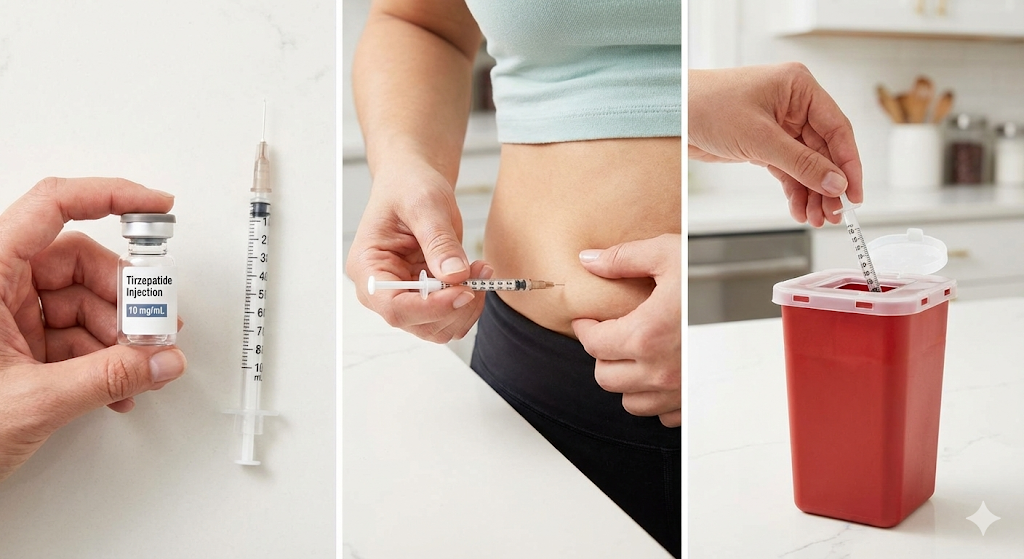
Use right syringe. Insulin syringes measure in units, where 100 units equals 1 mL. Some pharmacies send syringes marked in mL instead. Know which one you have, because drawing to 25 mark means very different things on each.
Inject subcutaneously, which means just under skin and into fatty layer. The three recommended sites are abdomen, front of your thigh, and back of your upper arm. Rotate sites each week so same spot does not get overused.
Store unopened vials in refrigerator between 36 and 46 degrees Fahrenheit. Let medication reach room temperature before injecting. Cold injections tend to sting more.
Dispose of needles in a sharps container. Not a regular trash can.
If anything about process feels unclear, contact your provider or pharmacist before you inject. Tirzepatide belongs to same GLP-1 receptor agonist class as other injectable medications you may have heard of. If you are curious about how different drugs in this class compare, this breakdown of Trulicity vs. Ozempic covers some of those differences.
Conclusion
How many units is 2.5 mg of tirzepatide depends on your vial's concentration. At 5 mg/mL it is 50 units. At 10 mg/mL it is 25 units. At 2.5 mg/mL it is 100 units. If you use a prefilled pen, pen handles it for you.
The formula is simple. Divide your mg dose by concentration, then multiply by 100. But if there is any doubt at all, call your pharmacist or provider before drawing up. Getting right dose is one step you cannot afford to get wrong.
Frequently Asked Questions
It depends on how far off you are. If you draw a bit less than needed, you get a slightly lower dose, which is not usually dangerous but may reduce medication's effectiveness that week.
If you draw more than prescribed, you increase risk of side effects like severe nausea, vomiting, diarrhea, dehydration, and in rare cases pancreatitis. Do not try to correct a dosing mistake yourself by drawing another shot to make up the difference. Call your prescribing physician or pharmacist instead. They can tell you whether to skip your next dose, wait, or take corrective action. When in doubt, always check with them before injecting.
Technically yes, Insulin syringes are specifically marked in units (where 100 units equals 1 mL), which makes converting from your vial concentration straightforward. Standard syringes are marked in mL only, so you have to convert your unit answer back into mL.
If your vial is 10 mg/mL and your dose is 2.5 mg, that is 0.25 mL on a regular syringe. If the pharmacy sent you a regular syringe instead of an insulin syringe, call them and ask for the correct one. Do not eyeball it. The volumes are small enough that even a minor visual estimation can throw off your dose.
This happens most often with compounded tirzepatide because compounding pharmacies mix medication in different concentrations depending on their supply, formulation, and patient demand. Brand-name Mounjaro and Zepbound prefilled pens do not change concentration. But if you get compounded tirzepatide from vials, your next batch may be 5 mg/mL when your last batch was 10 mg/mL.
which is why you have to check the label every single time. If the concentration changes without warning, that is not necessarily a problem, but ask your pharmacist why it changed. Some pharmacies send text messages about concentration changes, while others do not.
Hold the syringe up so the needle is pointing up and check that the liquid level lines up exactly with the unit mark you calculated. Look at the syringe at eye level, not from above or below, because parallax can distort what you see. Tap the syringe gently to send any air bubbles to the top, then push the plunger slightly to expel them. Bubbles take up volume that should be medication, so bubbles mean you inject less than intended. If you are new to injecting, ask your pharmacist to walk you through it in person once. Many pharmacies do this for free.
It depends on how much time has passed. If it has been less than 4 days since your scheduled dose, take it as soon as you remember, then continue on your regular weekly schedule. If more than 4 days have passed, skip the missed dose entirely and just take your next scheduled dose at your normal time.
Do not double up to compensate, because that increases your side effect risk. If you miss doses regularly, talk to your physician about adjusting your injection day to something that works better with your schedule. Consistency matters more with tirzepatide than with some other weekly medications.
