
A urine culture report tells you three things. First, whether bacteria grew in your urine sample. Second, what type of bacteria it is. And third, which antibiotics can treat it effectively. If your doctor ordered this test, it is usually because they suspect a urinary tract infection and want to confirm what is going on before choosing right treatment.
What Does "Colony Count" Mean?
This is first thing most labs report, and it is one of most important numbers on page. Colony count tells you how many bacteria were found in a specific volume of your urine, measured in colony forming units per milliliter (CFU/mL).
Here is how to interpret it. According to NCBI Bookshelf review on urine culture, most laboratories use 100,000 CFU/mL or more as standard cutoff for a positive urine culture. That means if your report shows 100,000 CFU/mL or higher of a single bacterial species, it is considered significant growth consistent with a urinary tract infection.
Counts below 10,000 CFU/mL are generally considered negative. Anything between 10,000 and 100,000 CFU/mL falls into a gray zone. Your doctor will look at those results alongside your symptoms to decide whether it represents an early or mild infection or possible contamination during sample collection.
It is worth knowing that newer guidelines from American Urological Association suggest that even counts above 1,000 CFU/mL can be significant if you are having clear UTI symptoms. So colony count alone does not tell whole story. Your symptoms matter just as much.
What Does "Organism Identified" Section Mean?
Once bacteria grow in lab, they identify exactly what type it is. This is organism or pathogen listed on your report. most common ones you will see in urine cultures include:
- Escherichia coli (E. coli): By far most common cause of urinary tract infections, responsible for roughly 80% of uncomplicated UTIs. It normally lives in intestines and can travel to urinary tract.
- Klebsiella pneumoniae: Another common bacterium, especially in people with catheters or recurrent infections.
- Enterococcus species: Often found in complicated UTIs or hospital-acquired infections.
- Proteus mirabilis: More common in men and in people with kidney stones.
- Pseudomonas aeruginosa: Typically seen in hospital settings or in people with catheters.
- Staphylococcus saprophyticus: More common in young women with uncomplicated UTIs.
If your report says "no growth" or "no significant growth," that means culture did not find bacteria at a level that suggests infection. If it says "mixed flora" or "mixed growth," it usually means sample picked up bacteria from skin or surrounding area during collection, and result may not be reliable. Your doctor might ask you to repeat test with a cleaner sample.
What Is "Sensitivity" or "Susceptibility" Section?
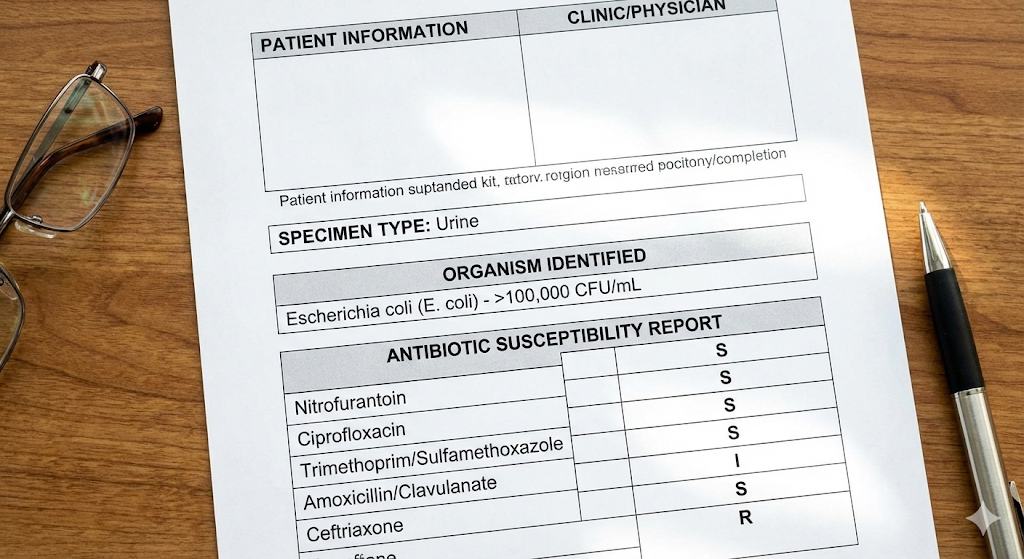
This is part that guides treatment. Once lab identifies bacteria, they test it against a panel of antibiotics to see which ones can kill it and which ones cannot.
You will typically see each antibiotic listed with one of three labels:
- S (Sensitive): The bacteria responds to this antibiotic. It is likely to work.
- I (Intermediate): The bacteria shows partial response. The antibiotic might work at higher doses, but it is not first choice.
- R (Resistant): The bacteria does not respond to this antibiotic. Using it would be ineffective.
Your doctor will use this section to pick most effective antibiotic for your specific infection. This is exactly why culture and sensitivity testing matters so much. It takes guesswork out of treatment and helps avoid prescribing an antibiotic that will not work. If your doctor prescribes something like nitrofurantoin based on sensitivity results, ook on Macrobid dosing for a UTI explains what to expect with that particular medication.
What If Report Shows More Than One Organism?
If two organisms show up, lab will usually report both with their individual colony counts and sensitivities. Your doctor will evaluate whether both are true pathogens or if one might represent contamination.
If three or more organisms are present, result is almost always considered contaminated. sample likely picked up skin bacteria during collection. In that case, lab may report it as "mixed flora" and your doctor will probably ask for a repeat sample using a careful midstream clean-catch technique.
How Long Does a Urine Culture Take?
Most urine cultures take 24 to 48 hours for initial results. The lab needs time for bacteria to grow on culture plate before they can identify it and run sensitivity testing. If no growth appears after 48 hours, culture is reported as negative.
This is why your doctor might start you on a common antibiotic right away based on your symptoms and urinalysis results while waiting for culture to come back. If sensitivity report shows that bacteria is resistant to what you were initially given, your doctor will switch you to a more appropriate antibiotic.
What About Urinalysis That Comes With It?
Many urine culture reports also include a urinalysis, which is a separate set of results from a dipstick or microscopic examination done before culture. This part of report might show things like white blood cells (indicating inflammation), red blood cells, nitrites (a sign of bacteria), leukocyte esterase, or protein.
If you notice something unusual on your urinalysis like mucus threads and are not sure what it means, this article on mucus threads in urine breaks it down clearly.
The urinalysis gives your doctor a quick snapshot while culture provides definitive confirmation. Together, they paint a complete picture of what is happening in your urinary tract.
When Should You Be Concerned?
Most urinary tract infections are uncomplicated and respond well to right antibiotic. But certain findings on a urine culture report deserve closer attention. If bacteria shows resistance to multiple antibiotics, your doctor may need to use a stronger or less common medication. If same organism keeps showing up on repeated cultures, it could indicate a structural issue, an incomplete previous treatment, or a persistent source of infection that needs further investigation.
If you develop fever, flank pain, chills, or nausea alongside a positive urine culture, that may suggest infection has moved beyond bladder to kidneys. That requires more urgent treatment, sometimes with intravenous antibiotics.
Bottom Line
A urine culture report has three core sections: colony count (how much bacteria), organism identification (what type of bacteria), and antibiotic sensitivity (what treats it). Counts at or above 100,000 CFU/mL typically confirm an infection. The sensitivity results guide your doctor to most effective antibiotic. If your report says no growth, that is reassuring. If it says mixed flora, you may need to repeat test. Understanding these basics can help you have a more informed conversation with your doctor about your results and treatment plan.
