
Health Library
Can You Drink Alcohol While Taking Mucinex?
February 16, 2026
Question on this topic? Get an instant answer from August.
It is best to avoid alcohol while taking Mucinex. The basic Mucinex formula (guaifenesin only) does not have a dangerous direct interaction with alcohol. But many Mucinex products contain additional ingredients like dextromethorphan and acetaminophen that can cause real problems when combined with drinking.
Even with basic Mucinex, alcohol can worsen your side effects, weaken your immune system, and slow your recovery.
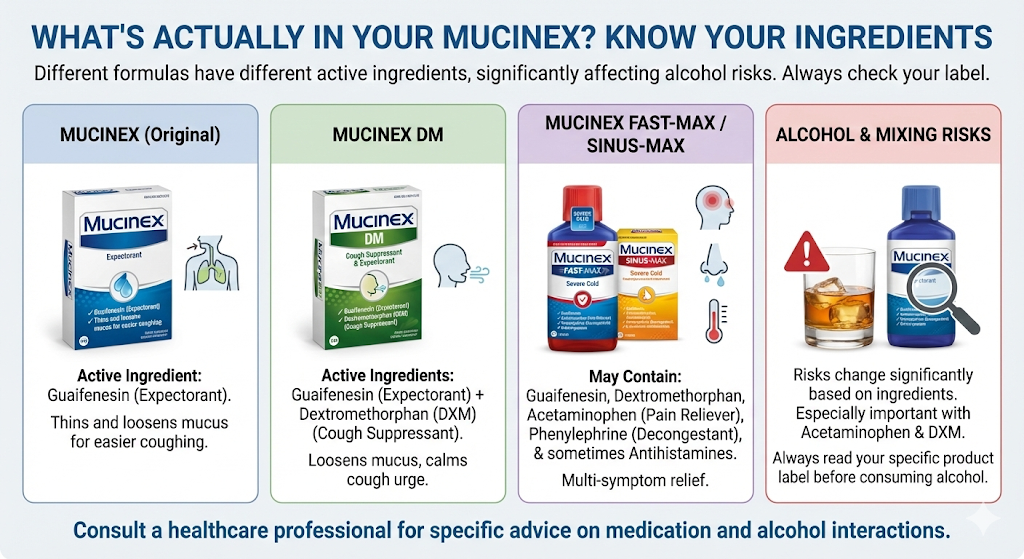
What Is Actually in Your Mucinex?
This matters more than most people realize. Mucinex is not just one product. It is a whole line of cold and flu medications, and each formula has different active ingredients.
Mucinex (original) contains only guaifenesin. This is an expectorant that thins and loosens mucus in your airways so you can cough it out more easily.
Mucinex DM contains guaifenesin plus dextromethorphan (DXM). DXM is a cough suppressant that calms your urge to cough.
Mucinex Fast-Max and Sinus-Max products can contain guaifenesin, dextromethorphan, acetaminophen (the active ingredient in Tylenol), phenylephrine (a decongestant), and sometimes antihistamines.
The risks of mixing with alcohol change significantly depending on which Mucinex product you are taking. So checking your specific label is important before making any decisions.
What Happens If You Mix Basic Mucinex with Alcohol?
Guaifenesin on its own does not create a dangerous interaction with alcohol. But that does not mean mixing the two is harmless.
Both alcohol and Mucinex can cause drowsiness, dizziness, and nausea. When you combine them, those side effects can stack up. You may feel more lightheaded or unsteady than you expected. Your coordination and reaction time may drop as well.
Alcohol also irritates your stomach lining. Guaifenesin can do the same. Together, you are more likely to experience nausea, stomach upset, or vomiting.
Then there is the bigger picture. Alcohol dehydrates you. It suppresses your immune system. It disrupts your sleep quality. All of these things work against your body when it is trying to fight off an illness. Taking Mucinex to relieve congestion while drinking alcohol is essentially working against yourself.
Why Is Mucinex DM More Risky with Alcohol?
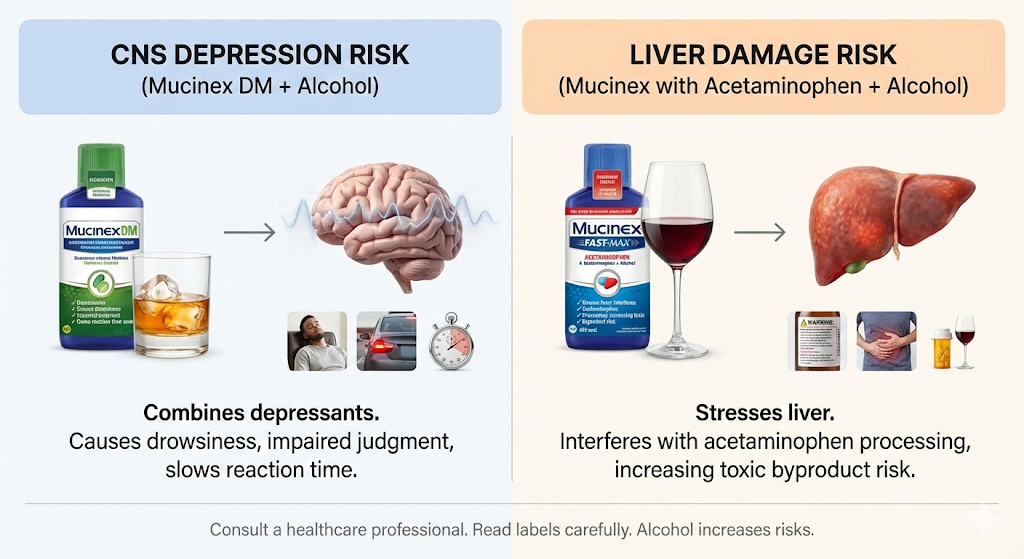
This is where the concern gets more serious. Mucinex DM contains dextromethorphan, which is a central nervous system depressant. Alcohol is also a central nervous system depressant. Combining two depressants amplifies their effects on your brain.
When mixed, DXM and alcohol can cause extreme drowsiness and sedation, impaired judgment and coordination, dizziness and confusion, slowed breathing, and an increased risk of falls or accidents.
In high doses, dextromethorphan combined with alcohol can be life threatening. The Drug Enforcement Administration has noted deaths linked to alcohol combined with high doses of DXM. Standard Mucinex DM doses are much lower than what is typically involved in those cases, but the interaction still increases your risk of dangerous side effects even at normal doses.
DXM can also cause euphoric or psychedelic effects at high doses. Alcohol impairs judgment and decision making. This combination may lead some people to take more DXM than intended, which raises the overdose risk further.
What About Mucinex Products with Acetaminophen?
This is the most medically serious concern. Several Mucinex products (especially the Fast-Max and Sinus-Max lines) contain acetaminophen.
Your liver processes both acetaminophen and alcohol. When it has to handle both at the same time, neither gets processed efficiently. Alcohol changes how your liver breaks down acetaminophen, producing more of a toxic byproduct that can damage liver cells.
The Mucinex label itself warns against drinking three or more alcoholic beverages daily while taking products that contain acetaminophen. But even smaller amounts of alcohol can put added stress on your liver, especially if you are taking acetaminophen regularly over several days of illness.
Severe liver damage from this combination is rare at normal doses and moderate drinking. But the risk is real, particularly for people who drink frequently, have existing liver conditions, or are taking other medications that also go through the liver.
How Long Should You Wait Between Mucinex and Alcohol?
If you have already taken Mucinex and want to have a drink, the general guidance is to wait 4 to 12 hours depending on the product you used.
Basic Mucinex (guaifenesin only) clears from your system relatively quickly. Waiting about 4 hours gives your body enough time to process most of it. Extended-release versions stay active much longer in your system, so you may need closer to 12 hours before it is safe.
Mucinex DM and products with acetaminophen take longer to metabolize fully. Waiting at least 12 hours is the safer choice with these formulas. If you are taking multiple doses throughout the day, the safest approach is to avoid alcohol entirely until you are done with the medication.
Your body size, age, metabolism, liver health, and other medications all affect how quickly you process these drugs. When in doubt, wait longer rather than shorter.
What If You Already Had a Drink?
If you accidentally had one drink while on Mucinex, do not panic. A single standard drink is unlikely to cause a serious reaction with a normal dose.
Stop drinking as soon as you realize the overlap. Drink water to stay hydrated. Watch for any unusual drowsiness, dizziness, or nausea. If you feel significantly worse than expected, contact your doctor or a pharmacist for advice.
The risks increase with the amount of alcohol. One drink is very different from three or four.
The Bottom Line
Basic Mucinex (guaifenesin alone) has a low direct risk with alcohol, but the combination still worsens side effects and slows your recovery. Mucinex DM adds dextromethorphan, which is a central nervous system depressant that amplifies alcohol's sedating effects. Mucinex products with acetaminophen add liver risk to the equation.
The safest choice is simple. Skip alcohol entirely while you are taking any Mucinex product. Your body is already working hard to get you healthy. Give it the best chance to do its job.
Health Companion
trusted by
6Mpeople
Get clear medical guidance
on symptoms, medications, and lab reports.

download august