
In earliest stages, pimple and cold sore can look almost identical. Both start as a small, red, slightly raised bump, often near lips or on face. But they are caused by completely different things and need different care. A pimple is clogged pore, while cold sore viral infection caused by herpes simplex virus.
Telling them apart early matters because cold sores are contagious and respond to antiviral treatment, while pimples are not contagious and respond to acne care.
What Does Pimple Look Like in Early Stages?
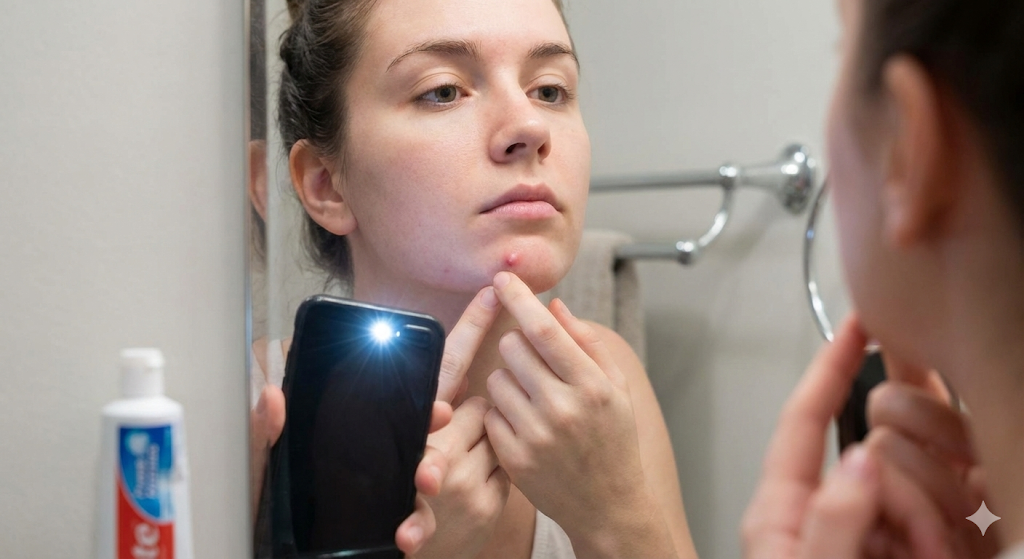
A pimple starts as a small, firm bump under skin. It forms when pore becomes clogged with oil, dead skin cells, and sometimes bacteria. In earliest stage, you may notice tiny red or pink bump that feels slightly tender to touch.
The key early signs of pimples include single bump that feels solid or slightly raised, mild tenderness when pressed, redness concentrated in one spot, and sometimes visible whitehead or dark plug (blackhead) at center. Pimples can appear anywhere on face, but when they form near lip line, they are most easily confused with cold sore.
According to U.S. National Library of Medicine, pimples form when tiny holes on surface of skin become clogged. Each pore opens to a follicle that contains hair and an oil gland. When oil gland becomes blocked with mixture of oil and skin cells, plug forms, and bacteria can get trapped inside it, triggering inflammation: Acne Overview
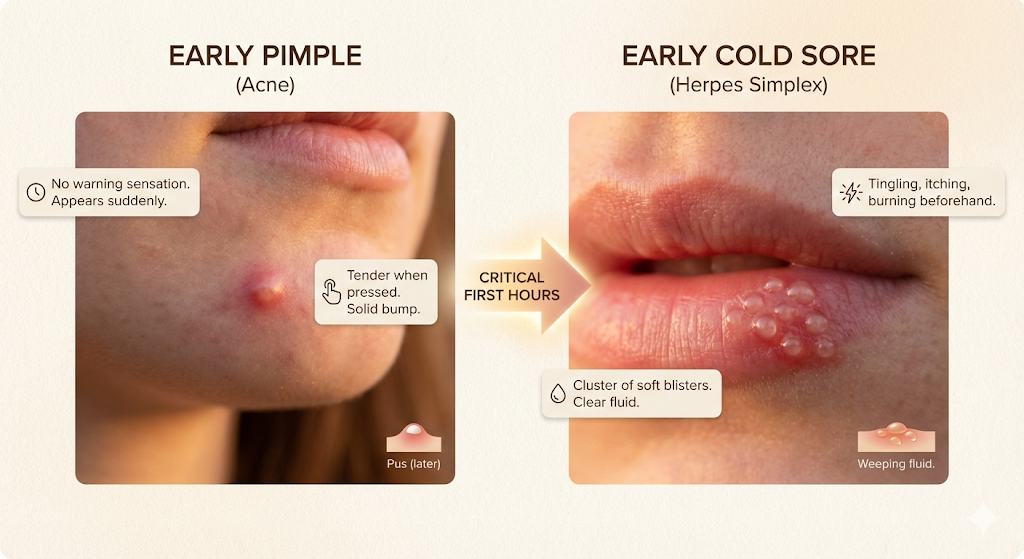
One important distinction: pimple does not tingle or burn before it appears. It just shows up. If you feel tingling or burning sensation in area before you see anything, that strong clue you are dealing with cold sore, not pimple.
What Does Cold Sore Look Like in Early Stages?
A cold sore starts very differently from pimple, even though the two can look similar at first glance. The earliest stage of cold sore is called prodromal stage, and it happens before anything visible on skin.
During this prodromal phase, you may feel tingling, itching, or burning sensation in a specific spot, usually on or near the lip border. This sensation can last anywhere from a few hours to full day before any bump appears. No pimple produces this kind of warning signal.
Once cold sore becomes visible, it typically appears as small cluster of tiny, fluid-filled blisters rather than single solid bump. The blisters are often grouped together in patch and may look slightly shiny or translucent in early hours.
The U.S. National Library of Medicine describes cold sores as small, painful blisters caused by herpes simplex virus, most commonly HSV-1. They usually appear outside mouth, on or around lips. Before blisters appear, there is often tenderness, tingling, or burning at site: Cold Sores and Oral Herpes
Cold sores are highly contagious from moment symptoms begin, even before blisters are fully formed. This is another reason early identification matters.
Side by Side Comparison: Early Stage Differences
Here is a direct comparison of key features to help you tell them apart in those critical first hours.
Location: Pimples can appear anywhere on face, including chin, forehead, nose, and cheeks. Cold sores almost always appear on lip border (vermilion border) or just outside it. If bump directly on fleshy part of your lip, it much more likely to be a cold sore.
Sensation before appearing: Pimples give no warning. They just appear. Cold sores almost always start with tingling, itching, or burning at site hours before they become visible.
Texture and shape: A pimple feels like a single, firm, solid bump. A cold sore feels like cluster of tiny, soft blisters. Even very early on, if you look closely, you may see multiple tiny raised dots grouped together rather than one solid lump.
Pain quality: A pimple is tender when pressed. A cold sore can itch, burn, and sting without being touched.
Fluid: Pimples may eventually produce white or yellow pus if they come to head. Cold sores produce clear, watery fluid from blisters. If you see clear fluid weeping from bump near your lip, that is almost certainly cold sore.
If you want more detailed visual comparison between herpes-related bumps and regular pimples, this guide goes deeper into distinguishing features: Herpes vs Pimple: Signs You Shouldn't Ignore
Can You Get Pimple on Your Lip?
Yes, but it is uncommon to get true pimple directly on lip itself. Pimples form inside pores, and fleshy part of your lip (vermilion) does not have same type of oil-producing pores that surrounding skin does. You can get pimple on skin immediately around lip, along lip line, or on chin, but bump directly on lip more likely cold sore than acne.
If you see a bump right at edge of lip where skin meets lip, this most common overlap zone where pimples and cold sores get confused. In this area, pay close attention to tingling test. If it tingled before it appeared, lean toward cold sore. If it just showed up as firm bump with no warning, it more likely pimple.
What Happens Next? How They Progress Differently
Watching how bump changes over next 24 to 48 hours will give you clearest answer.
A pimple will typically stay as a single bump. It may grow slightly, develop white or yellow head, become more tender, and then gradually shrink as it drains or your body reabsorbs contents. It does not spread or form new bumps nearby.
A cold sore follows more predictable pattern. The initial tingling gives way to cluster of small blisters. Within day or two, those blisters merge and fill with clear fluid. After two to four days, they burst and form shallow, weeping sore. A yellowish crust then forms as sore heals, and whole process takes about seven to fourteen days.
If you notice that bump near your lip is progressing through these blister-to-crust stages, you are almost certainly dealing with cold sore.
When Should You See Doctor?
Most pimples and cold sores resolve on their own. But there are situations where doctor visit is good idea.
You should see doctor if sore near your lip does not heal within two weeks, if it keeps coming back in same spot (a strong sign of herpes recurrence), if you develop fever, swollen lymph nodes, or severe pain, if you have weakened immune system, or if this is your first outbreak and you are unsure what it is.
If you find yourself frequently dealing with bumps on your face that are difficult to identify, it may also help to understand how similar looking conditions like folliculitis compare to herpes. The distinction between infected hair follicles and viral blisters can be just as tricky: Folliculitis vs Herpes: Key Differences
Bottom Line
In earliest stages, pimple and cold sore can look nearly identical. The fastest way to tell them apart is tingling test. If you felt tingling, burning, or itching at site before anything appeared, it is very likely cold sore. If firm bump just showed up with no warning, it is probably pimple. Location helps too: bumps directly on lip border lean toward cold sore, while bumps on chin, cheeks, or forehead are almost always pimples. When in doubt, quick visit to your doctor can give you clear answer and right treatment.
