
The Short Answer: Amoxicillin Clears Out Quickly
For most healthy adults, amoxicillin has a very short life in the body. The majority of a single dose is cleared from your system within 8 to 12 hours.
But the real answer is a bit more nuanced. To truly understand how long does amoxicillin stay in your body, we need to talk about a concept called “half-life.”
People also ask
Your body has a set process for clearing antibiotics that cannot be artificially accelerated. Focusing on staying hydrated is the best way to support your kidneys as they naturally filter out the medication.
Most people do not physically feel the drug leaving their body. Any sensations you experience, like a return of symptoms or lingering side effects, are more likely related to the infection or your body adjusting to the treatment.
Understanding Amoxicillin’s Journey Through Your Body (The Half Life Explained)
When doctors and pharmacists talk about how long a drug lasts, they often refer to its amoxicillin half life.
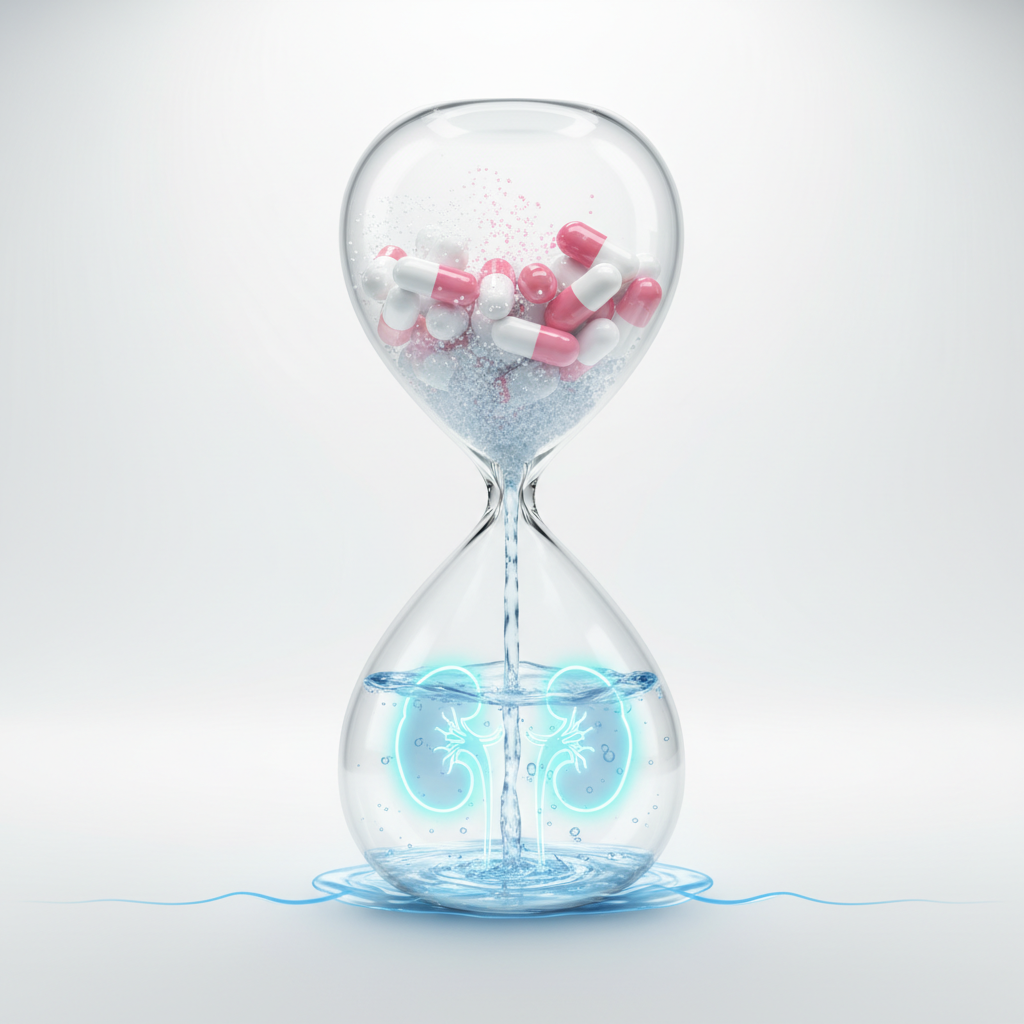
A drug’s half life is the time it takes for the concentration of that drug in your bloodstream to be reduced by exactly half (50%). Think of it like a countdown timer that keeps resetting at half the previous value.
Amoxicillin has a very short half life of approximately 60 to 90 minutes. Some clinical data places it very precisely at around 61.3 minutes source.
Here’s what that looks like in practice:
- After 1 hour: 50% of the amoxicillin dose is gone.
- After 2 hours: 75% of the dose is gone (half of the remaining 50%).
- After 3 hours: 87.5% of the dose is gone.
- After 4 hours: Over 93% of the dose is gone.
This rapid countdown continues until the drug is virtually undetectable. It generally takes about 5 to 6 half-lives for a drug to be fully eliminated from the body. For amoxicillin, this means that for a healthy person, it’s almost entirely gone within 6 to 8 hours. So, how many hours until amoxicillin is out of your system? Typically, less than half a day.
So, Where Does It Go? The Amoxicillin Elimination Pathway
Your body is an incredibly efficient processing plant. The primary organ responsible for showing amoxicillin the door is your kidneys. After the drug circulates through your bloodstream and does its job fighting bacteria, your kidneys filter it out and excrete it through your urine. In fact, about 60% of an amoxicillin dose is passed out of the body unchanged in your urine within six to eight hours of taking it source.
This is why doctors often ask about your kidney health before prescribing certain medications—your kidneys are the star players in the amoxicillin elimination process.
Key Factors That Influence How Long Amoxicillin Stays in Your System
While 8-12 hours is a good rule of thumb, it’s not the same for everyone. Several factors affecting amoxicillin clearance can speed up or, more commonly, slow down how quickly your body processes it.
1. Kidney Function (The Most Important Factor)
This is the big one. Since the kidneys do the heavy lifting, their health is the single most important factor determining how long amoxicillin stays in your body.
For someone with healthy, well functioning kidneys, the process is quick and efficient. However, for individuals with impaired kidney function (like those with chronic kidney disease), the elimination process slows down significantly. The drug lingers in the bloodstream for much longer because the body’s filtering system isn’t working at full capacity. This is a crucial aspect of amoxicillin and kidney function; doctors must often adjust the amoxicillin dosage for these patients to prevent the drug from building up to potentially toxic levels source.
2. Age (Newborns and the Elderly)
Age plays a significant role in drug metabolism.
- Newborns and Infants: A baby’s kidneys are not yet fully developed. Their filtering system is still getting up to speed, so they clear amoxicillin much more slowly than older children and adults.
- The Elderly: As we age, our kidney function naturally declines. An older adult might clear the drug more slowly than a younger one, even if they are otherwise healthy. This is why doctors are particularly careful when prescribing medications to the elderly.
3. Dosage and Body Weight
It’s simple logic: the more of a substance you put into a system, the longer it takes to get it all out. A higher amoxicillin dosage will naturally take a bit longer to be fully eliminated than a lower one.
This is also why body weight matters, especially for children. Pediatric doses are often calculated based on a child’s weight in kilograms to ensure the concentration is both effective and safe for their smaller systems.
4. Hydration Levels
Are you drinking enough water? Good hydration supports healthy kidney function. When you’re well hydrated, your kidneys can efficiently filter waste products—including medications—from your blood. While being extra hydrated won’t flush the drug out dramatically faster, being dehydrated can put a strain on your kidneys and slightly slow the elimination process.
5. Other Medications
Sometimes, other drugs can compete for the same exit ramp out of the body. A classic example is a medication called probenecid, often used to treat gout. Probenecid works by blocking the excretion of certain drugs, including penicillin-type antibiotics like amoxicillin, from the kidneys. This causes amoxicillin levels to remain higher in the blood for longer, which is sometimes done intentionally to boost the antibiotic’s effectiveness source.
People also ask
Even mild changes in kidney function can cause the drug to remain in your system for a longer duration than expected. This can lead to a higher accumulation of the medication in your bloodstream over time.
Some medications, particularly those used for gout or certain chronic conditions, can block or slow down how your kidneys excrete antibiotics. This interaction can cause levels to stay elevated in your body longer than intended.
The Critical Importance of Finishing Your Full Prescription
This might be the most important takeaway of this entire article. You start taking amoxicillin and, after a few days, you feel a hundred times better. The sore throat is gone, the fever has broken, and you feel like you’re back to normal. It’s incredibly tempting to stop taking the pills.
Do not do it.
The topic of stopping amoxicillin early is a serious one. Here’s why completing the full course—typically 7 to 10 days—is non-negotiable:
- The Strongest Bacteria Survive: An antibiotic course is like a battle. The first few doses knock out the weakest bacteria, which is why your symptoms improve quickly. But the tougher, more resilient bacteria are still hanging around. If you stop the medication, these survivors can multiply, and your infection can roar back, often worse than before.
- The Risk of Antibiotic Resistance: This is a major global health threat. When you stop a course early, you essentially give the surviving bacteria a training session. They get exposed to a low dose of the antibiotic, learn how to fight it, and can become “superbugs” that are resistant to future treatment. This makes infections harder, and sometimes impossible, to treat in the future source.
Think of it this way: how long does amoxicillin last in terms of its job? The full prescribed duration. It’s designed to wipe out the entire bacterial army, not just the front lines.
People also ask
Stopping early risks leaving the strongest, most resilient bacteria alive to multiply. This not only invites a rebound of your original infection but also encourages the development of antibiotic resistance.
Finishing the course is actually a protective measure for your long-term health. It helps prevent future infections from becoming harder to treat by stopping bacteria from evolving resistance.
Managing Common Side Effects and Allergic Reactions
While amoxicillin is a lifesaver, it can come with some unwanted guests. It’s crucial to know the difference between a common side effect and a serious allergic reaction.
First, a quick note on what does amoxicillin treat. As a broad-spectrum antibiotic, it’s a go-to for many common bacterial infections, including: * Ear, nose, and throat infections (like strep throat and sinusitis) * Chest infections like pneumonia and bronchitis * Urinary tract infections (UTIs) * Skin infections * Dental abscesses
Common Amoxicillin Side Effects
Most side effects are mild and related to your digestive system. This is because amoxicillin can’t tell the difference between bad bacteria and the good bacteria in your gut. Common issues include:
- Nausea or vomiting
- Diarrhea
- Changes in taste
- Headache
Pro Tip: Taking your amoxicillin dose with a meal or a snack can often help reduce stomach upset. If you experience persistent diarrhea, contact your doctor, as it could be a sign of a more serious issue.
Signs of a Serious Allergic Reaction
While rare, a true allergy to amoxicillin can be life-threatening. The amoxicillin allergy symptoms are very different from side effects and require immediate medical attention. Call 911 or go to the nearest emergency room if you experience any of the following after taking amoxicillin source:
- Hives (raised, itchy red welts on the skin)
- Swelling of the face, lips, tongue, or throat
- Difficulty breathing or wheezing
- Dizziness or fainting
Conclusion: Quick to Go, But Follow the Rules
So, how long does amoxicillin stay in your system? For the average healthy person, it makes a swift exit, with most of a dose cleared in under 12 hours. The speed of this process hinges heavily on factors like your age and, most importantly, your kidney health.
However, the short duration of the drug in your body underscores the most critical rule of antibiotic use: always finish the entire prescribed course. Even though the drug leaves your system quickly, each dose is a necessary step in the battle to completely eradicate the infection and prevent the rise of dangerous, drug-resistant bacteria.
If you have leftover medication, do not flush it down the toilet or save it for later. Dispose of it safely through a pharmacy take-back program to protect others and the environment.
Your health is paramount. If you have any concerns about your treatment, the factors affecting amoxicillin clearance, potential side effects, or your dosage, the best course of action is always to speak directly with your healthcare provider or pharmacist. They can provide personalized advice to ensure you get better safely and effectively.
Summary
Glyburide micronized is a prescription sulfonylurea used to help manage blood sugar in adults with type 2 diabetes. It works by stimulating the pancreas to release more insulin, helping lower blood glucose levels. The micronized formulation is designed to be absorbed efficiently and is generally taken with meals as prescribed.
While glyburide can be effective for blood sugar control, it can also cause side effects, with low blood sugar (hypoglycemia) being one of the most important risks. People with kidney or liver problems may need additional monitoring or a different treatment. Glyburide should only be taken at the prescribed dose, and you should not stop or change your medication without talking to your healthcare provider.
If you take glyburide, regular blood sugar monitoring and follow-up with your healthcare provider can help ensure the medication remains safe and effective for your diabetes treatment plan.
Frequently Asked Questions
Amoxicillin is mostly eliminated from the body within about 8 hours after the last dose in people with normal kidney function. The exact time can vary based on kidney function, age, dose, and overall health.
Amoxicillin is primarily eliminated through the kidneys and can remain in the urine for several hours after a dose. Most of the medication is generally cleared within about 8 hours in people with normal kidney function.
Amoxicillin has a short half-life of about 1 hour and is eliminated relatively quickly. Most of a dose is usually cleared from the body within several hours, although it may take longer when kidney function is reduced.
Amoxicillin reaches peak blood levels relatively quickly after an oral dose. Because it has a half-life of about 1 hour, blood levels decrease substantially over the next several hours as the medication is eliminated.
Yes. Since amoxicillin is primarily removed by the kidneys, reduced kidney function can slow its elimination. People with kidney problems may need an adjusted dose or dosing schedule from their healthcare professional.
Amoxicillin starts working against susceptible bacteria after you take a dose, but it can take a few days for infection symptoms to improve. Take amoxicillin exactly as prescribed and complete the course unless your healthcare professional tells you otherwise.
Common side effects such as nausea, diarrhea, and stomach discomfort often improve after stopping amoxicillin, although the duration varies. Severe or persistent diarrhea, a widespread rash, swelling, or trouble breathing requires prompt medical attention.
Stopping amoxicillin before completing the prescribed course may allow the infection to persist or return and can contribute to antibiotic resistance. Follow your healthcare professional's instructions about how long to take the medication.
